
Insights · Collection 01 · Part III
Why GEO Is Bigger Than SEO for AI
SEO helps information get found. GEO asks a larger question: once intelligent systems find the information, what are they able to understand, trust, and conclude from it?
By Eric Wing
Essay · 13 min read ·
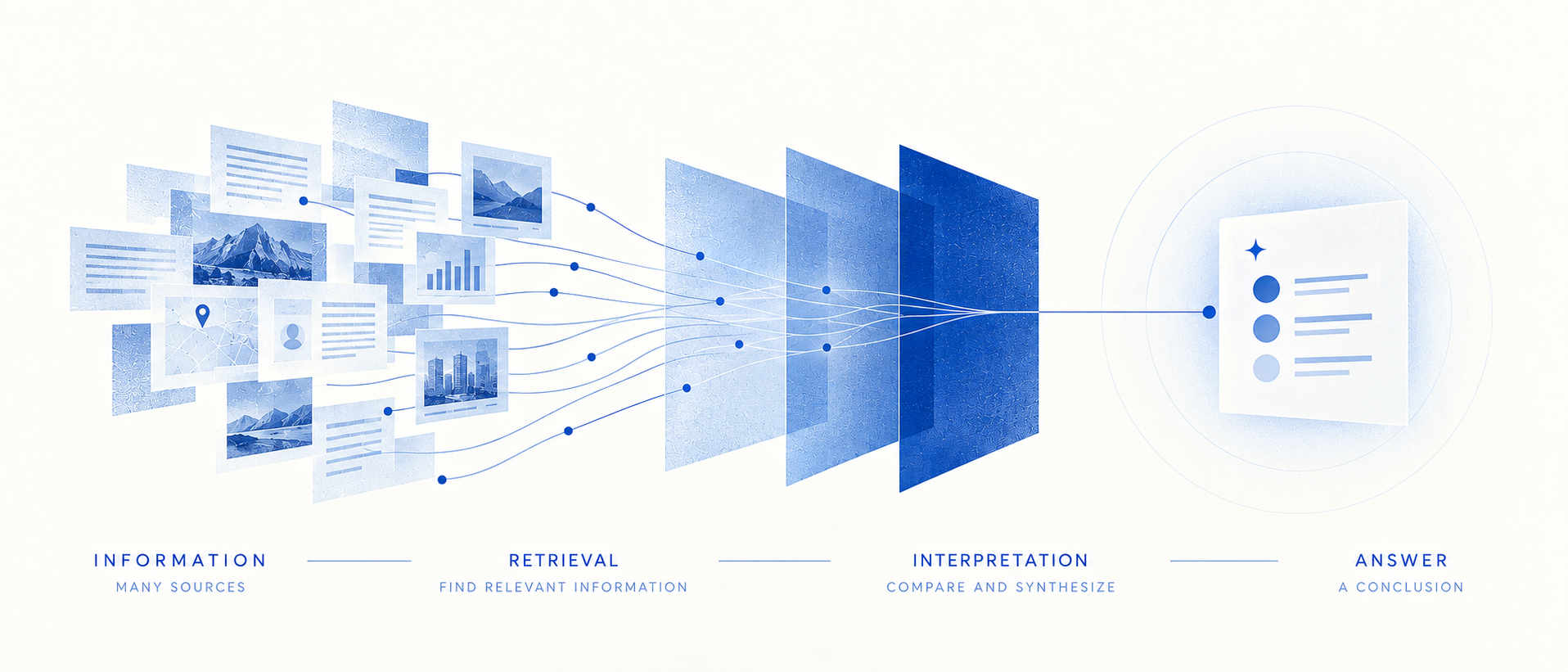
For most of the history of digital marketing, the basic model was fairly easy to understand. People searched. Search engines returned information. Organizations worked to appear in those results. An entire discipline grew around that relationship. Search engine optimization helped websites become accessible, relevant, authoritative, and easier for search engines to retrieve when someone went looking for an answer.
So when people began using ChatGPT, Gemini, Perplexity, AI Overviews, and other generative systems to find information, a familiar idea emerged almost immediately. Maybe we simply need a new version of SEO. Optimize for Google, and we call it SEO. Optimize for an AI system, and we call it GEO: Generative Engine Optimization.
There is truth in that idea. Google’s current guidance makes essentially that case for its own search environment. The fundamentals that help content perform in traditional Search — technical accessibility, useful content, clear structure, accurate information, and established SEO practices — also matter to Google’s generative search experiences. That makes sense. But it describes the problem from inside a search engine.
Zoom out a little further and something else starts to become visible. The important change is not simply that AI gives us a new place to search. It’s that the system between the question and the answer is starting to do more.
SEO solved an enormous retrieval problem
The internet created access to more information than any person could reasonably navigate on their own. Search engines made that information useful. They crawled webpages, organized them, evaluated relevance and authority, and tried to retrieve the best possible results for whatever someone typed into a search box.
SEO developed alongside that system. Technical SEO helped search engines access websites. Content optimization improved relevance. Links established relationships and authority. Site architecture created structure. Local SEO connected organizations to places. Search intent helped marketers understand what people were actually trying to accomplish.
None of that has stopped mattering. The foundation is still the foundation. But SEO developed primarily around a particular challenge: Can the right information be found?
The intelligence layer adds another: What happens after it is found?
Interpretation is moving upstream
Think about the traditional search experience. Someone has a question. A search engine retrieves a set of possible sources. The person opens several of them, reads, compares, evaluates credibility, reconciles disagreements, and eventually forms a conclusion. Search performs an enormous amount of work, but much of the final interpretation still happens in the person’s head.
Generative systems compress that middle. Google describes AI Search experiences that can retrieve information related to multiple dimensions of a question and synthesize that material into a response. Perplexity describes itself as an answer engine that searches for sources and synthesizes what it finds. ChatGPT can search the web for current information and provide source citations. Microsoft similarly describes generative experiences that retrieve information and use it to construct answers.
The systems do not all work the same way. Their models, indexes, retrieval methods, ranking systems, and interfaces differ. But the larger change is easier to see.
The traditional process looked roughly like this:
Question → Search → Sources → Human interpretation → Conclusion
Increasingly, another path looks like this:
Question → Retrieval → Sources → Machine interpretation → Answer → Human
The difference isn’t simply where the answer appears. It’s where some of the interpretation occurs. And once interpretation moves upstream, optimization begins to mean something broader.
The page is no longer the whole unit of competition
Traditional SEO has often worked around a fairly direct relationship. A person enters a query. A search engine determines which pages are relevant. Those pages compete for visibility. The model has become far more sophisticated over the years, but the webpage remains an important unit. We optimize pages around intent, usefulness, authority, user experience, and technical accessibility because pages are what search engines retrieve and people visit.
Generative discovery introduces another layer. Imagine someone asks: Who are the leading employee benefits consultants for mid-sized employers in Boston?
A consulting firm might have an excellent page about employee benefits consulting in Boston. That page still matters. But it may not be the only evidence available. There could also be team biographies showing decades of benefits experience. Industry directories. Association memberships. Conference appearances. Client testimonials. Case studies. News coverage. Geographic information. Articles written by the firm’s executives. Other websites referring to its expertise.
The system may encounter some combination of those sources while trying to determine which organizations belong in the answer. So the question is no longer only: Can this page rank? It can become: Does the available evidence support the conclusion that this organization belongs in the answer?
That’s a much larger optimization surface.
Ranking and recommendation are different outcomes
This is where the distinction between SEO and GEO becomes especially useful. A traditional search result creates an opportunity to be encountered. The person still has to decide whether the organization belongs in their consideration set.
A generative answer may perform part of that narrowing first. It may mention three companies rather than show ten blue links. It may summarize why one provider is relevant. It may omit another entirely. It may answer the question without requiring the person to visit a website at all.
That doesn’t make rankings unimportant. It means ranking and inclusion are not the same outcome. A page can be highly relevant to a search query while the organization behind it remains weakly understood in the larger information environment. We’ve already explored this distinction in the Darby analysis Can a Company Rank Well in Google but Be Invisible in ChatGPT?
Good SEO creates strong conditions for AI visibility. But strong SEO does not automatically equal strong AI visibility.
Google’s “GEO is SEO” argument still matters
There is a temptation whenever a new discipline emerges to make the old discipline sound obsolete. I don’t think that’s useful here.
Google is right to emphasize the continuity. Its generative Search experiences still depend heavily on the same information ecosystem traditional Search depends on. A technically inaccessible website doesn’t suddenly become easier for AI to understand. Thin content doesn’t become authoritative simply because a generative interface is involved. Poor architecture, vague service definitions, weak evidence, and inconsistent entities remain problems.
Within Google’s own environment, the distinction between SEO and GEO may remain especially blurry. But Google’s definition doesn’t necessarily define the entire emerging information environment. The intelligence layer described in Part I is larger than one search engine. People are increasingly asking systems to research, compare, summarize, evaluate, and recommend.
So I don’t think GEO is bigger because SEO has somehow become less important. I think GEO becomes bigger when the objective expands beyond retrieval and ranking. SEO helps machines find the information. GEO asks what they are able to conclude from it.
The optimization target expands from pages to evidence
This is the larger shift. If the goal is only to retrieve a page for a query, the relationship between that page and that query naturally becomes central. But if the system is trying to answer a broader question about an organization, the optimization target starts to expand.
It may need to understand: What does this company do? Who does it serve? Where does it operate? What is it particularly good at? What evidence supports those claims? Who else associates it with that expertise? What do customers say? What do independent sources say? Are its people credible? Are the descriptions consistent? How does it compare with alternatives?
Those answers rarely live on one page. They live across an information environment. Part II of this series explored what happens when AI encounters an organization through distributed signals rather than through the brand strategy the company holds internally. That’s where the idea of Signal Architecture becomes important: the deliberate organization of digital evidence that helps human and machine audiences arrive at a clearer understanding of an organization.
Part III adds the consequence. If the evidence is distributed, then optimizing machine understanding cannot be confined to optimizing webpages.
GEO starts to cross traditional marketing boundaries
Organizations naturally divide digital work into disciplines. SEO. Content. PR. Reputation. Web development. Social media. Executive communications. Structured data. Case studies. Partnerships. Those distinctions are operationally useful.
But an intelligent system does not necessarily care which department produced the information. A case study can become evidence of expertise. A review can become evidence of reputation. An executive biography can establish subject-matter experience. A professional association can establish an industry relationship. A location page can establish geography. A news article can corroborate an event or capability. Structured data can clarify an entity relationship. A service page can establish relevance.
What an organization manages as separate marketing channels can converge into one information environment. Or put another way: What marketers call channels, machines may encounter as evidence.
This is where GEO starts to look less like a new SEO tactic and more like a systems discipline.
More content isn’t automatically the answer
There is a predictable response to almost every new digital marketing problem: Produce more. More pages. More articles. More mentions. More profiles. More schema. More content aimed at more prompts.
That is probably the wrong lesson. If generative systems are trying to interpret a wider evidence environment, volume alone doesn’t solve the problem. A hundred generic articles do not necessarily establish expertise better than five genuinely useful pieces. Repeating the same claim on ten pages does not create independent corroboration. Creating profiles that nobody maintains can eventually create contradiction rather than clarity. Publishing material specifically to manipulate AI systems can produce plenty of information without producing much useful evidence.
The goal shouldn’t be maximum signal volume. It should be better evidence. Clearer information. Useful expertise. Accurate representation. Relevant relationships. Fewer contradictions. Stronger corroboration where it legitimately exists. A digital environment that reflects the real organization well.
That’s a very different mindset from trying to find the next ranking shortcut.
The measurement problem expands too
SEO gave us a mature vocabulary for measuring visibility. Rankings. Impressions. Clicks. Organic traffic. Conversions. Those measures still matter.
But once the system starts participating in interpretation, additional questions emerge. Is the organization mentioned? Is its information cited? For which questions? Around which topics? How is the company described? Which competitors appear instead? Which sources are shaping the answer? Are important areas of expertise missing? Does the organization appear only when someone searches for it by name, or also when they search for the category? Are descriptions consistent across systems? Are AI systems sending referral traffic?
A mention and a citation don’t even mean the same thing. A company might be mentioned without its website being used as a visible source. A page might be cited without the organization itself being recommended. That distinction is why Darby’s analysis of AI mentions versus AI citations treats them as separate forms of visibility. Neither metric tells the whole story.
And that points toward a broader truth about GEO measurement. There may never be one equivalent of “we rank number three.” Generative systems are variable. Answers change. Sources change. Context changes.
The useful measurement may increasingly be found in patterns: How often are we included? Where are we absent? Which topics consistently connect to us? How accurate is the representation? Which sources repeatedly influence the answer? Is the picture improving over time?
That requires a more observational view of digital visibility.
SEO is the foundation, not the boundary
This is where I think the relationship between SEO and GEO ultimately lands. Good SEO remains essential. Websites need to be technically accessible. Information needs to be understandable. Content needs to be useful. Search demand still tells us a great deal about what people care about. Site architecture, entities, structured information, authority, reputation, and content quality all continue to matter. The intelligence layer didn’t erase the information layer beneath it. It depends on it.
But the job is no longer necessarily finished when a page becomes retrievable. A system may retrieve the information and then compare it. Connect it to other information. Determine what entity it belongs to. Evaluate supporting evidence. Resolve inconsistencies. Place an organization within a category. Summarize a reputation. Infer an area of expertise. Decide what belongs in an answer.
That is where GEO begins to extend beyond conventional SEO. Not because search disappears. But because interpretation has entered the path between search and decision.
The question after “Do we rank?”
For years, one of the most important questions an organization could ask about its digital presence was: Do we rank?
It remains an important question. But increasingly, it may be followed by others. Does the intelligence layer understand us? What does it associate us with? What evidence does it find useful? Where is the picture incomplete? Where does outside evidence reinforce what we say about ourselves? Where does it contradict us? And when someone asks for an organization like ours, are we part of the answer?
These aren’t merely SEO questions. They’re questions about how an organization exists inside a larger information environment.
For most of the internet’s history, organizations worked to make information available. Search made that information discoverable. Now intelligent systems are beginning to interpret it.
Which creates a new question for digital visibility: When machines assemble the evidence that exists about us, what conclusion do they reach?
And eventually, perhaps the most consequential question of all: Is that conclusion strong enough for them to recommend us?
That is where this series goes next.
Sources & further reading
- Google Search Central, “Optimizing your website for generative AI features on Google Search”
- Google Search Central, “AI features and your website”
- OpenAI Help Center, “ChatGPT search”
- Perplexity Help Center, “What is an answer engine and how does Perplexity work?”
- Microsoft Learn, “Use public websites to improve generative answers”
Explore Darby’s approach to Generative Engine Optimization →
This is Part III of “The Intelligence Layer,” a series by Eric Wing exploring how artificial intelligence is changing search, knowledge, digital identity, and the way organizations are understood online.
Part III of IV
Next: The Companies AI Will Recommend. Part IV examines how evidence of a company’s capabilities can support recommendations and better buying decisions.
View the full collection →