
Insights · Collection 01 · Part I
AI Is Becoming the Intelligence Layer Above the Internet
For most of its history, the internet has been something we navigate. That relationship is starting to change — and the shift may be one of the more consequential in the history of the web.
By Eric Wing
Essay · 12 min read · June 2, 2026

We visit websites, search Google, follow links, open articles, compare sources, read reviews, watch videos. We gather information and eventually form our own conclusions.
The technology has changed a lot over the past three decades, but the basic relationship has stayed pretty consistent: the internet provides information, and humans interpret it.
That relationship is starting to change. Increasingly, we’re not asking AI systems simply to show us information from the internet. We’re asking them to understand the information for us.
From publishing to information to intelligence
One way to think about this is as a series of layers.
The early web was mostly a publishing layer. Organizations, institutions, and individuals could suddenly put information in front of a global audience. A company could build a website. A newspaper could publish online. A university could make its research available beyond campus.
Then the internet matured into an information layer. Search engines organized an exploding volume of webpages and made them findable. The defining challenge stopped being whether information existed and became whether you could find the right piece of it. Search engines became the roads and signposts for that world. You asked a question, the search engine pointed you toward some possible answers, and you did the rest. Much of what we still call search and discovery work was built for exactly that world.
AI is changing that relationship. Systems like Google Search and ChatGPT can now retrieve information from across the web and synthesize it into a single response. Google has described the evolution of Search as moving "beyond information to intelligence," and its AI Search experiences increasingly blend search, reasoning, and agentic capability.
The interface still looks familiar. There's a box. There's a question. But something has shifted behind it. The system is no longer just helping us find information. It's helping us interpret it.
Searching and asking aren't the same thing
Someone searches: "Best project management software for a 20-person architecture firm." A traditional search engine hands back ten links, and the user does the rest of the work themselves. They open several sites, compare features, read reviews, decide which sources seem trustworthy, reconcile the disagreements, and eventually land on a conclusion.
Now ask an AI system the same question. It might search several sources, identify relevant products, weigh their features against each other, factor in the size and type of the company, summarize the tradeoffs, and hand back a recommendation. The user still makes the final call, but a lot of the cognitive work has moved upstream.
The old process looked something like this: question, search, sources, reading, comparison, interpretation, decision. Increasingly it looks more like: question, retrieval and comparison and interpretation happening together, answer, decision. That compressed middle section matters. It's where the intelligence layer is taking shape.
Interpretation is becoming infrastructure
The internet has always contained interpretation. Journalists interpret events. Analysts interpret markets. Academics interpret research. Every field has people whose job is essentially to make sense of raw material on someone else's behalf.
What’s new is the possibility that interpretation itself becomes a basic technical function above the internet’s information layer, something a machine does as a matter of course. A system can encounter dozens of sources and start working out what matters, which information is relevant, where sources agree and where they conflict, what relationships connect the facts, and what the best answer actually is to the question being asked.
This isn't just faster search. It's a change in the role technology plays between raw information and human understanding. For the first time at real scale, machines are sitting between the world's information and the people trying to make sense of it.
AI is starting to answer
This is part of why I think "AI search" only describes part of what's happening. Search implies retrieval: find this, locate that, show me where something exists. But increasingly we're asking systems to explain, compare, tell us what matters, recommend something, spot the contradiction, summarize the argument, help us decide.
The shift may go further still. In May 2026, Google described a more agentic version of Search, one capable of taking actions on a user's behalf rather than just answering questions. That points toward a rough progression: information, then interpretation, then recommendation, then action. At each stage, a little more responsibility moves from the person navigating the information to the system interpreting it.
A new intermediary between us and knowledge
Knowledge has always been shaped by intermediaries. Libraries organized information. Publishers decided which books were worth printing. Editors decided which stories mattered. Search engines added another layer by deciding which pages showed up when we went looking.
But search still mostly pointed you toward sources. You still had to encounter the disagreement yourself. AI introduces a different kind of intermediary, one that can synthesize the sources before you ever see them.
Ask why the Roman Empire fell, and a search engine will show you historians, encyclopedias, universities, videos, essays, all with their own emphases and disagreements. An AI system, on the other hand, may just synthesize those perspectives into one coherent explanation. It isn't merely retrieving knowledge anymore. It's constructing a representation of it.
From information abundance to interpretation abundance
The internet solved one enormous problem and created another. For most of human history, information was scarce. The internet made it abundant. But that abundance created a new kind of scarcity: attention.
Search engines solved part of that by ranking pages. Social platforms tried to solve it through recommendation. AI offers another approach: synthesis. Instead of deciding which ten pages you should read, the system tries to read the relevant material on your behalf and tell you what it means.
If the great achievement of the information age was making knowledge accessible, one of the achievements of this next stage may be making that knowledge interpretable. But that creates a scarcity of its own: trust. The more interpretation we hand off, the more trust starts to matter.
What does the intelligence layer know?
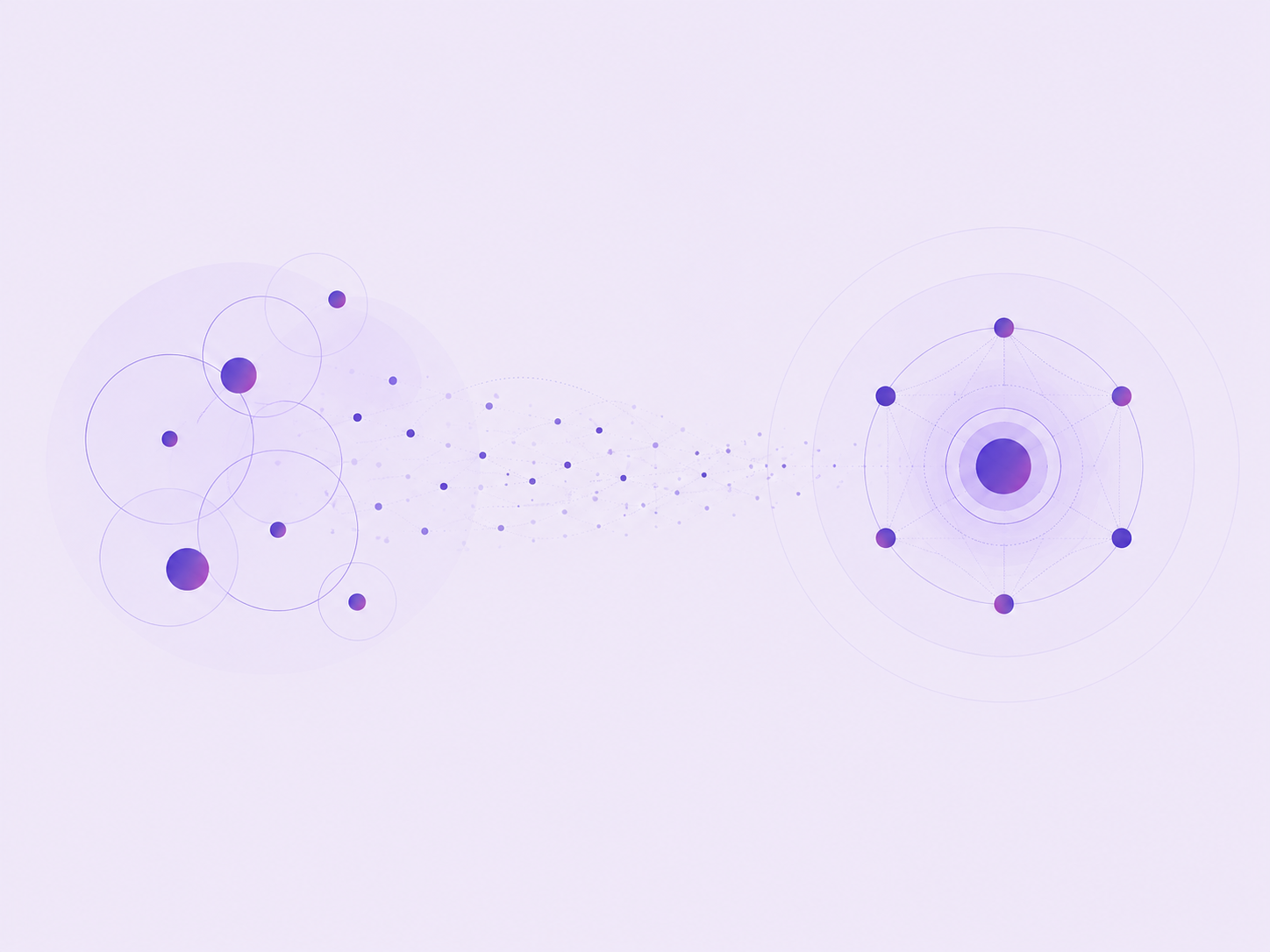
The intelligence layer isn't just building representations of facts and ideas. It's building representations of entities: people, companies, products, organizations, places, institutions, professions, events.
Take a business. The business knows what it does. Its website describes what it does. Its customers describe their own experience of it. Then there's everything else feeding into the picture: Google Business Profiles, directories, media coverage, reviews, social activity, industry sites, videos, and a long tail of other signals. An AI system encounters all of that and forms its own interpretation.
Which leads to a strange situation. There can end up being three versions of an organization: who it actually is, how it represents itself online, and what the intelligence layer concludes it is. A company can have a strong reputation with its customers and still be poorly understood by AI. It can be credible but under-corroborated, visible but not understood, or understood but never recommended. This is the kind of gap our marketing optimization work is built to find.
The machine is becoming an audience
Organizations have traditionally built their digital presence for people. Websites are written for people. Case studies are meant to persuade people. Marketing, broadly, is aimed at people.
But there's now another audience taking in all of that material: machines. Not in the crude sense of "write content for robots" though. Google's current guidance for AI-driven Search actually leans on familiar fundamentals: useful, original content, solid technical accessibility, accurate structured data, and material created primarily for people rather than for algorithms.
The more interesting implication is that machines are now trying to understand information that was created almost entirely by humans, for humans. Which means every organization now has to think about a second question alongside the old one. It's no longer just "what do people see when they find us," but "what can a machine actually understand about us before a person ever shows up?"
Machine understanding comes before machine recommendation
A system can't confidently recommend something it doesn't understand. And it can't easily understand something when the available evidence is inconsistent, vague, or thin. That creates a rough sequence: discovered, then understood, then validated, then trusted, then recommended, then selected. Visibility is only the first step in that chain.
For years, digital marketing put most of its energy into that first step. Can we get found? SEO got remarkably good at helping organizations show up in search results, and that fundamentals-level work still matters. But generative search adds a further layer of questions. Does the system actually understand what you do? Can it corroborate what you're claiming about yourself? Can it tell you apart from similar organizations?
This territory is often called Generative Engine Optimization, or GEO. But I suspect GEO will end up being bigger than just optimizing content to get included in AI-generated answers. The deeper discipline is probably about optimizing machine understanding itself, which is the thinking behind Darby’s GEO approach.
The internet no longer ends at the webpage
For decades, the website was the destination. Marketing built awareness, search created discovery, the website did the persuading, and the user converted.
That path still exists, but another one is forming alongside it: from the web, into the intelligence layer, through interpretation, to a recommendation, and then to a decision. In that version, a company's information can shape a decision even when the person never visits the page it came from. A case study becomes evidence. A review becomes evidence. An executive's bio becomes evidence.
The webpage isn't just a destination anymore. It's also a contribution to a larger information environment that machines draw understanding from.
We need a broader way to think about the internet
Websites aren't disappearing. Search isn't disappearing. SEO isn't disappearing. People aren't going to stop visiting sources and weighing information for themselves. This shift is additive, not a replacement.
But something significant is getting inserted between the internet’s information and human understanding. An AI intelligence layer is taking shape above the web. It retrieves, connects, interprets, summarizes, recommends, and increasingly acts. The result isn’t simply a better search engine. It is an environment where information is increasingly processed before it ever reaches us.
Maybe the biggest question is this: what happens when we stop using the internet just to find knowledge, and start relying on AI to help us decide what that knowledge means?
We’re only starting to find out. But the direction seems clear enough. The internet remains the information layer. AI is becoming the intelligence layer above it.
Sources & further reading
This is Part I of "The Intelligence Layer," a series by Eric Wing exploring how artificial intelligence is changing search, knowledge, digital identity, and the way organizations are understood online.
Part I of IV
Next in the collection: AI Doesn’t See Your Brand the Way You Do, and Why That Matters for GEO →
View the full collection →