
Insights · Analysis
What Is the Difference Between an AI Mention and an AI Citation?
Being mentioned by AI and being cited as a source are different forms of visibility. Understanding both creates a clearer picture of how an organization appears in generative discovery.
By Eric Wing
Analysis · 8 min read ·
AI visibility is beginning to generate its own measurement vocabulary.
Two of the terms that come up most often are mentions and citations.
They sound similar. They measure different things.
An AI system can mention a company without citing its website. It can cite a company’s page without meaningfully mentioning the company in the answer. And neither outcome necessarily means the system is recommending the organization.
That distinction matters because it changes what an organization is actually measuring.
A mention tells us something about whether the organization became part of the answer. A citation tells us something about whether its information became part of the evidence.
Both matter. But they answer different questions.
A practical definition of an AI mention.
An AI mention occurs when an organization, brand, product, person, or other entity appears by name in an AI-generated response.
For example, imagine someone asks:
“Which residential painting companies should I consider around Boston?”
If the generated response names several companies, each of those organizations has gained a form of AI visibility. The system included the company in its interpretation of the question.
That is the important part.
The company did not necessarily receive a link. Its own website may not have been used as a source. And being mentioned does not necessarily mean it was endorsed. The answer could describe the company positively, neutrally, comparatively, or even critically.
So the useful question behind a mention is:
“Did the organization become part of the answer?”
Mention
The entity appears in the generated answer.
A practical definition of an AI citation.
A citation occurs when an AI-generated response identifies a webpage or domain as a source supporting the answer.
Depending on the platform, that may appear as:
- an inline link
- a source reference
- a citations panel
- a linked footnote
- another visible source treatment
The important distinction is that the page is being used as evidence.
The system may cite:
- the organization’s homepage
- a service page
- an article
- a case study
- a research page
- a third-party source
- a review site
- an industry publication
The organization itself does not necessarily have to be the subject of the answer. For example, an AI response discussing a marketing trend might cite a Darby Insights article without recommending Darby as a digital marketing company. That would still represent a citation.
The useful question behind a citation is:
“Did our information become part of the evidence supporting the answer?”
Citation
A page or domain is identified as a source.
Mentions and citations can overlap. They do not have to.
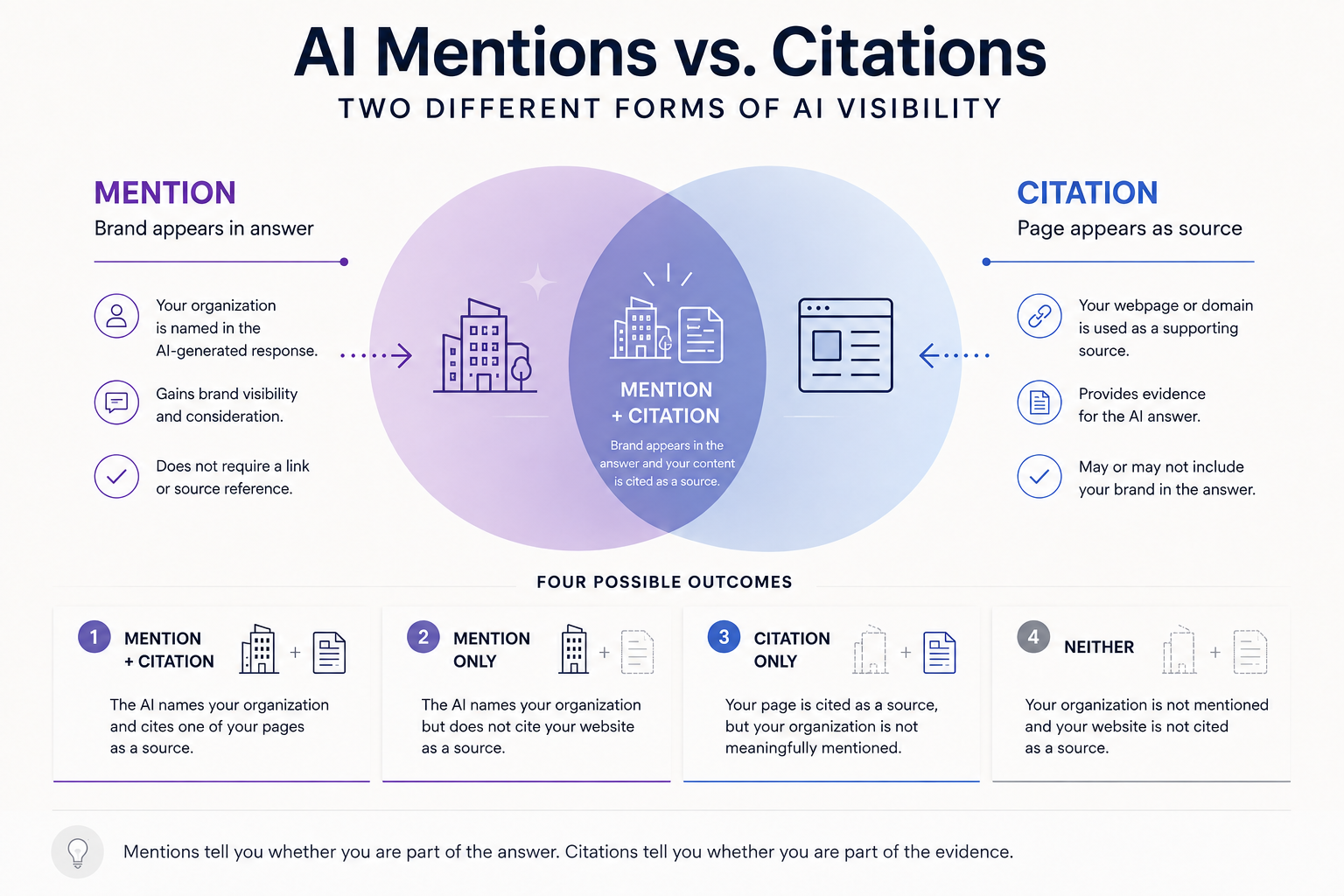
Four situations are possible:
1 · Mention + Citation
The AI answer names the organization and cites one of its pages. This is the clearest overlap between brand visibility and source visibility.
2 · Mention without Citation
The AI answer names the organization but uses other sources, background knowledge, or retrieved information to support the answer. The brand gained visibility. Its website did not necessarily gain source visibility.
3 · Citation without a Meaningful Brand Mention
A Darby article, research page, case study, or other resource could be cited because it contains useful evidence even when Darby itself is not part of the recommendation or discussion. The information gained visibility. The organization may not have.
4 · Neither
The organization is absent from both the generated answer and its visible supporting sources. This is why tracking only one metric can produce an incomplete picture.
Why AI mentions matter.
Mentions are closest to what people traditionally think of as brand visibility.
If someone asks:
- Who should I consider?
- Which companies specialize in this?
- Who are the leading providers?
- What organizations are known for this?
and your organization appears in the answer, it has entered the consideration environment.
That can matter even without a click.
A person may learn the company exists. They may see it compared with competitors. They may ask a follow-up question. They may search for the brand later. They may form an impression before ever visiting the website.
But mention count alone is incomplete.
A company could be mentioned frequently in questions that do not matter commercially. The description could be inaccurate. The sentiment could be weak. The company could appear only because someone explicitly included its name in the prompt. Or competitors might appear in substantially more valuable contexts.
So Darby would not treat total mentions as a standalone success metric.
Why AI citations matter.
Citations tell us something different.
They indicate that a page has become useful enough within a generated answer to be surfaced as supporting evidence. That can matter for several reasons.
A cited page can:
- influence how an answer is constructed
- reinforce an organization’s authority around a topic
- create referral traffic
- expose proprietary information or evidence to a new audience
- show which parts of the website AI systems find useful
- reveal which third-party sources are shaping the category
Citations can therefore help answer:
“What information is the system relying on?”
That is particularly useful when comparing your organization with competitors. If a competitor is frequently mentioned but your company is not, look at what sources support those answers. If your pages are cited but your company is rarely mentioned, that reveals a different problem.
The two metrics together create a much more useful diagnostic.
A citation is not the same as a recommendation.
This distinction is especially important.
An organization may see that its website was cited in ChatGPT, Perplexity, Google AI experiences, or another system and conclude:
“AI recommends us.”
That conclusion may not be justified.
A source can be cited simply because it contains information useful to the answer. The cited organization might not be recommended. It might not even be discussed. Likewise, a company can be mentioned in a recommendation without its own website being cited.
So keep three ideas separate:
- Inclusion
- The organization appears.
- Evidence
- The organization’s information is cited.
- Recommendation
- The organization is presented as a relevant choice.
They can occur together. They do not mean the same thing.
There is no single universal way to count them.
This is another important complication in AI visibility measurement.
Different monitoring platforms can use slightly different definitions and counting rules. One tool may count a mention once per generated response even if the company name appears several times. Another reporting environment may aggregate visibility by prompt, brand, platform, page, or domain.
Citation reporting can differ too. Some platforms expose citations prominently. Others expose source information differently. And AI visibility tools are ultimately observing samples of generated responses, not every private AI conversation happening across the world.
So when comparing data:
Do not compare two metrics based only on their labels. Understand what the tool is actually counting.
The most useful questions are:
- What constitutes one mention?
- Is the metric counted by prompt or by appearance?
- Is citation reporting page-level or domain-level?
- Which AI platforms are included?
- How often are prompts tested?
- What prompt set is being measured?
- Are custom prompts included?
- Are results sampled or exhaustive?
Although individual platforms and monitoring tools may count these differently, the basic distinction holds. The methodology behind the number matters almost as much as the number itself.
How Darby would measure mentions and citations together.
Darby would treat mentions and citations as two signals inside a larger AI visibility picture. A useful baseline can include:
- Mention rate
- How often does the organization appear across a relevant set of prompts?
- Citation rate
- How often are the organization’s pages used as visible sources?
- Prompt context
- Which questions actually produce the visibility?
- Platform
- Does visibility differ across ChatGPT, Gemini, Perplexity, Google AI experiences, and other relevant systems?
- Competitors
- Which organizations appear when yours does not?
- Cited sources
- Which pages and domains are repeatedly influencing answers?
- Description accuracy
- When the organization appears, is it being represented correctly?
- Recommendation context
- Is the organization simply named, compared, supported as evidence, or actually presented as an option?
The objective is not to maximize one number.
The objective is to understand the pattern.
What can help an organization earn more mentions?
Mentions tend to raise a broader entity-level question:
Does the information environment give the system enough reason to associate this organization with the subject?
Darby would examine signals such as:
- entity clarity
- service and category relevance
- demonstrated expertise
- case studies
- reviews
- reputation
- geographic relevance
- third-party corroboration
- consistent descriptions
- industry relationships
- topical authority
- competitive prominence
This is not a formula.
There is no single tag or page change that makes an AI system mention a company. The objective is to strengthen the evidence connecting the organization to the contexts where it genuinely belongs.
What can help an organization earn more citations?
Citation opportunity raises a somewhat different question:
Does the organization publish information worth using as evidence?
That may include:
- original research
- clear explanations
- useful definitions
- proprietary data
- case-study evidence
- specific statistics
- well-supported analysis
- expert commentary
- structured factual information
- content that answers a question directly
Technical accessibility still matters.
A system cannot use information effectively if it cannot retrieve or interpret it. But citation opportunity is not simply a technical problem. The information itself has to contribute something useful.
This is one reason generic marketing copy has limited value as a citation strategy.
“Darby provides exceptional digital marketing services” is a claim. A documented case study showing what changed, what was measured, and what happened is evidence. Those are very different information assets.
The strongest outcome may be when the two reinforce each other.
Mentions and citations become particularly interesting when they converge.
Imagine an AI system answering a question about companies with expertise in a particular problem. It understands what your organization does. Independent signals support that association. Your own website contains strong evidence. Your articles help explain the subject. Your case studies demonstrate the work. The system includes the organization in the answer and uses credible information connected to it as supporting evidence.
That is a much stronger information environment than simply trying to get a company name inserted into generated responses.
It also explains why GEO is broader than content optimization alone. The organization itself has to become understandable. And the information around it has to become useful. Our reference guide covers the foundations of GEO in more detail.
Mentions tell you whether you are part of the answer. Citations tell you whether you are part of the evidence.
That is the simplest distinction.
An AI mention answers: Did we appear?
An AI citation answers: Was our information used?
Neither metric tells the entire story. Neither guarantees recommendation. Neither should be interpreted without understanding the prompts, platforms, competitors, sources, and context behind it.
But together, they provide a useful view into two different parts of AI visibility: whether machines recognize the organization as relevant, and whether they recognize its information as useful.
That is why Darby tracks them separately.
Sources & further reading
Want to understand where your organization appears, and why?
Darby’s Generative Engine Optimization work looks beyond a single AI visibility score. We evaluate mentions, citations, competitors, sources, entity clarity, and the broader signals influencing how generative systems understand and represent an organization.
Continue the idea
- Can a Company Rank Well in Google but Be Invisible in ChatGPT?
Strong Google rankings do not automatically translate into AI visibility.
- AI Doesn’t See Your Brand the Way You Do, and Why That Matters for GEO
How AI systems infer who an organization is from distributed signals.